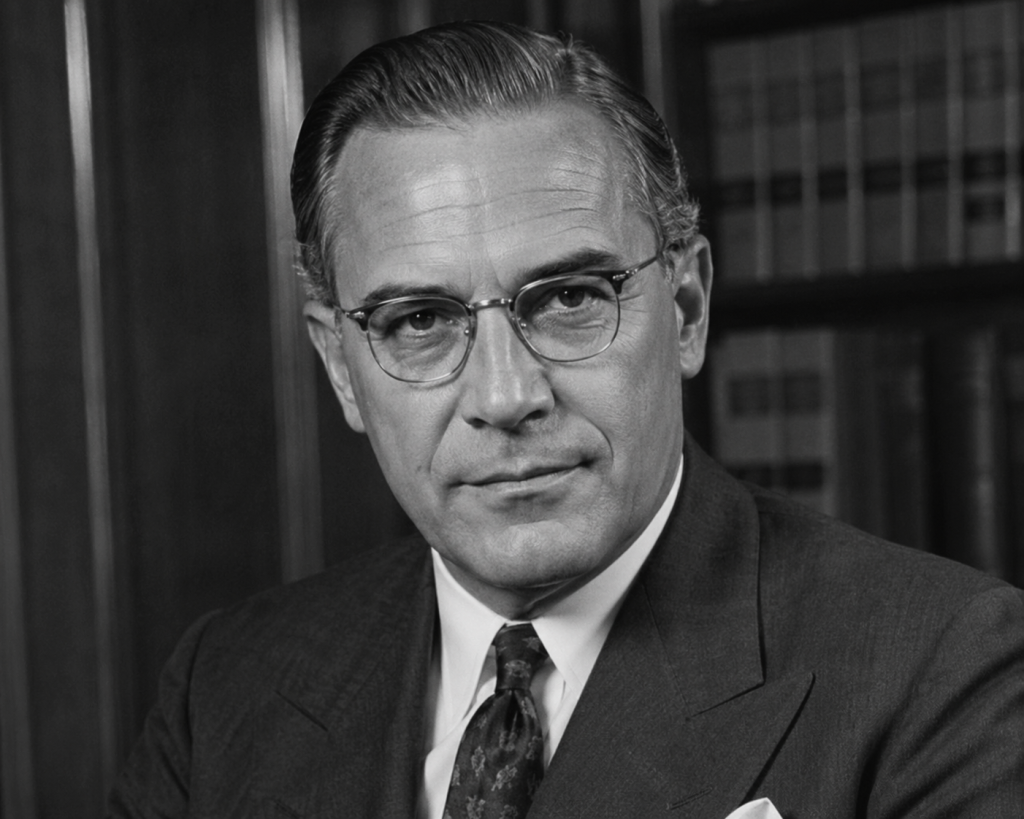
Leonard William Mortimer was born on 14 March 1893 in Hexham, Northumberland, the son of a country solicitor. He went up to Trinity College, Cambridge in October 1911, took a First in Part I of the Classical Tripos in 1913, and switched to Law for Part II, taking a First in 1914. He spoke fluent German. His father had arranged for him to be sent at the age of ten to a Gymnasium in Heidelberg, where he boarded for two years between 1903 and 1905. He returned to England with the German of a German schoolboy, which is to say close to native, and kept it up afterwards through correspondence with his Heidelberg housemaster and through reading. By the time he went up to Cambridge he could read Goethe, Schiller and the German legal commentaries with no difficulty.
The fluency shaped what happened to him in the Great War. He was commissioned into the Royal Garrison Artillery in late 1914 and served briefly with his battery in 1915, but in early 1916 his German was noticed and he was seconded to the Intelligence Corps as an interrogating officer attached to a divisional headquarters on the Western Front. The work was the careful questioning of captured German prisoners, the reading of captured documents, and the preparation of intelligence summaries for divisional and corps commanders. He was at Passchendaele in the autumn of 1917 and at the Hindenburg Line in 1918 in this capacity rather than as a gunner. The war taught him that careful documentary and interrogative work could establish facts that no amount of operational reporting could capture. He spoke about the Western Front rarely.
He was called to the Bar at Lincoln’s Inn in 1920. His pre-war legal practice had been in commercial and tax matters at the chambers of W. R. Hempson at Pump Court in the Temple. The German fluency, in the inter-war period, had its uses. Several of his commercial cases involved German chemical and banking firms with London business; he could read the underlying contracts and correspondence in their original language without the delay and small inaccuracies of a translation bureau, and he could examine German witnesses in court without an interpreter. He had a reputation among colleagues for thoroughness rather than brilliance, for the careful preparation of long documentary cases, and for an unusual willingness to do the unglamorous archival work that complex commercial litigation required. He had married Margaret Bell, a barrister’s daughter from Newcastle, in 1922. They had two sons, Edward born 1924 and Henry born 1927. Edward was killed flying with Bomber Command over the Ruhr on 30 March 1944. Henry survived the war and became a doctor.
The Second World War found him too old for combat duty but obviously useful elsewhere. From the spring of 1940 he was attached, on the Lord Chancellor’s Department’s recommendation, to the legal staff of the Political Warfare Executive at Woburn Abbey, working on the legal preparation of materials for German consumption. From October 1943 he was seconded to the United Nations War Crimes Commission in London, an Allied body that used the wartime sense of “United Nations” (the alliance against the Axis powers, before the United Nations Organisation was founded in October 1945) and that had been established by seventeen Allied governments to assemble the documentary basis for the prosecution of German war crimes after the war. The Commission was building, even before the war ended, an archive of captured documents, witness statements and case dossiers running into hundreds of thousands of pages. Mortimer’s work on the Commission gave him, by VE Day, a working familiarity with the documentary record on German war crimes that almost no other English barrister possessed. The selection for Nuremberg in the autumn of 1945 was the natural next step.
Mortimer arrived in Nuremberg in early September 1945, around eleven weeks before the trial opened on 20 November. The British case had to be built from a captured documentary record that was still arriving by the lorry-load through the autumn; the work of indexing, classifying and preparing it for use in court occupied the team continuously through the pre-trial weeks. He was titled Clerk to the British Prosecution. The role was administrative on its surface. In practice he was the senior figure on the British team responsible for the management of the documentary evidence. Every German record that came into British possession passed through his office at the Palace of Justice. He read it in the original German, indexed it, classified it, decided which of the British team’s barristers should examine it, and tracked which documents were used in court. He kept the master log of the British evidence book. The opening speeches of December 1945 and the closing speeches of July 1946 drew their documentary substance from the catalogues he had built. He worked, for the entire eight months of the main trial, at a small desk on the second floor of the Palace of Justice, surrounded by filing cabinets and a small permanent staff of three assistants.
The work changed him. He had not, before Nuremberg, been a man with strong views on much. He came back to London in October 1946 with strong views on most things. The documentary record he had handled day by day for eight months had been, on his own later description, a kind of induction into a side of human behaviour he had not previously taken seriously. He spoke about Nuremberg, in private, for the rest of his life.
The documents that passed through his hands at Nuremberg included the Wannsee minutes, the Höfle telegram, the Stroop report bound in the original SS leather, the Korherr report, the Posen speeches and the Auschwitz construction office files. By the end of the eight months of the main trial he had handled, in the original German, the bulk of the surviving German documentary record on the killing programme.
Mortimer returned to private practice in 1947 but did not return to his old chambers. He took chambers of his own at 5 Old Square, Lincoln’s Inn, with two younger barristers he had recruited. He took silk in 1958 as Queen’s Counsel. His post-war practice was at the senior end of commercial and equity work; he chose not to take criminal cases on principle, the principle being that he had handled enough criminal evidence at Nuremberg to last a lifetime.
He was a regular contributor to the legal-historical literature on Nuremberg. His monograph The British Prosecution at Nuremberg: A Personal Recollection (Stevens and Sons, 1962) was the first substantial English-language account of the British case from inside the team. It remains a primary source for the historians who have written on Nuremberg since. The Hartley Shawcross archive at Churchill College Cambridge, deposited in the 1980s, contains substantial Mortimer correspondence; Mortimer’s own papers were given to Lincoln’s Inn Library in 1973 and constitute a separate archive in their own right.
He retired from practice in 1968 and lived in a small house in Hampstead with Margaret until her death in 1981. He himself died on 14 May 1987 at the age of ninety-four, three days after the Klaus Barbie trial had opened in Lyon. He had read about the opening in The Times and remarked to his nurse that he had hoped to live long enough to see how the French would do it.